 Email:
  Telephone: +86-0514-85086085
 FAX: +86-0514-85086085
 English
 中文简体
中文简体 русский
 عربى
عربى
Content
What Is Minimum Circuit Ampacity?
Minimum circuit ampacity (MCA) is the minimum current-carrying capacity a circuit's wiring must have to safely power a specific piece of equipment. It is a calculated value — not the equipment's running amperage — that accounts for continuous load requirements, motor inrush characteristics, and code-mandated safety margins. In the United States, the National Electrical Code (NEC) Article 440 governs MCA calculations for motor-driven equipment such as HVAC units, compressors, and refrigeration systems.
The standard NEC formula for MCA on motor-compressor equipment is: MCA = 1.25 × (largest motor FLA) + sum of all other loads on the circuit. For example, an air conditioner with a compressor drawing 14A and a fan motor drawing 3A would have an MCA of (1.25 × 14) + 3 = 20.5A. The supply conductors must be sized to carry at least 20.5A — meaning 12 AWG copper minimum under standard NEC Table 310.12 conditions, though most installers would select 10 AWG to also meet the maximum overcurrent protection requirement on the same nameplate.
MCA is distinct from the maximum overcurrent protection (MOCP) rating, which sets the ceiling for the breaker or fuse size. Wire must be sized to the MCA; the overcurrent device must be sized between the MCA and the MOCP. Both values are required by NEC 440.4(B) to be marked on the equipment nameplate. Using wire smaller than the MCA — even if protected by a correctly sized breaker — is a code violation and a fire hazard because the conductor cannot safely carry the continuous load the equipment demands.
Wire Ampacity by Gauge: Copper and Aluminum
Ampacity — the maximum continuous current a conductor can carry without exceeding its insulation temperature rating — is determined by wire gauge (AWG or kcmil), conductor material (copper or aluminum), insulation temperature rating, and installation method. The values below are based on NEC Table 310.12 for conductors in conduit or cable at 60°C and 75°C insulation ratings in a 30°C ambient, which are the most common real-world installation conditions. Ampacity is reduced when multiple current-carrying conductors share a conduit (derating applies at 4 or more conductors), when ambient temperature exceeds 30°C, or when conductors are bundled in free air.
| AWG / Size | Copper 60°C (A) | Copper 75°C (A) | Aluminum 75°C (A) | Typical Breaker Size |
|---|---|---|---|---|
| 14 AWG | 15 | 20 | — | 15A |
| 12 AWG | 20 | 25 | 20 | 20A |
| 10 AWG | 30 | 35 | 30 | 30A |
| 8 AWG | 40 | 50 | 40 | 40–50A |
| 6 AWG | 55 | 65 | 50 | 60A |
| 4 AWG | 70 | 85 | 65 | 70–80A |
| 2 AWG | 95 | 115 | 90 | 100A |
| 1/0 AWG | 125 | 150 | 120 | 125–150A |
| 3/0 AWG | 165 | 200 | 155 | 175–200A |
10 Gauge Wire Max Amps
10 AWG copper wire has a rated ampacity of 30A at 60°C and 35A at 75°C per NEC Table 310.12. In residential wiring — where most devices and terminations are rated for 60°C — the practical limit is 30A, which is why 10 AWG is paired with 30A breakers for electric dryer circuits, large window air conditioners, and EV charger branch circuits. The 75°C column value applies only when all terminations, devices, and equipment on the circuit are rated for 75°C, which is the case in many commercial and industrial applications using 75°C-rated breakers and panels.
Max Amps for 8 Gauge Wire
8 AWG copper wire carries 40A at 60°C and 50A at 75°C. The 60°C value governs residential installations; 8 AWG is therefore the minimum for a 40A circuit and is used for large appliance circuits and some sub-panels. At the 75°C rating, 8 AWG can support 50A loads in commercial wiring where 75°C terminations are confirmed throughout the circuit. Note that 8 AWG aluminum wire carries 40A at 75°C — one practical gauge size smaller than copper for the same ampacity, which is why aluminum is less commonly used at this gauge in branch circuit wiring despite its lower cost per foot.
Ampacity of 4 AWG Copper
4 AWG copper is rated at 70A (60°C) and 85A (75°C). It is commonly specified for 70A and 80A feeder circuits, sub-panel feeds in residential additions, and branch circuits for large commercial kitchen equipment. At 75°C, 4 AWG copper can technically support an 85A load, though breaker coordination typically lands at 80A as the next standard size below 85A.
Wire Sizing for Common Service and Feeder Applications
What Size Wire for a 50 Amp Breaker?
A 50A circuit requires 6 AWG copper or 4 AWG aluminum at a minimum. The NEC requires that branch circuit conductors be sized at no less than the overcurrent device rating for non-motor, non-HVAC circuits — so 50A breaker means 50A-rated wire. At 75°C, 8 AWG copper reaches 50A, but because most residential receptacle and panel terminations are rated 60°C, the 60°C column governs and 8 AWG's 40A limit is insufficient. Use 6 AWG copper with a 50A breaker for standard residential 240V circuits such as EV Level 2 chargers, hot tubs, and ranges.
Wire Size for 100 Amp Service
For a 100A residential service entrance or feeder, 2 AWG copper or 1/0 AWG aluminum is the standard selection. At 75°C, 2 AWG copper carries 115A — sufficient margin above 100A for the service. Service entrance conductors are permitted to use the 75°C column per NEC 230.42 because utility-side and meter base connections are rated accordingly. The copper option is more compact but more expensive; aluminum is the cost-effective choice for longer service runs and is the dominant material for residential service entrance cable in North America.
1/0 Aluminum Wire for 100 Amp Service
1/0 AWG aluminum is rated at 120A at 75°C, making it the standard conductor size for 100A residential service entrance and feeder applications when aluminum is used. It is specified in service entrance cable (SEU or SER type) and in conduit runs from the meter base to the main panel. Using 1/0 aluminum for 100A service is fully NEC-compliant at 75°C terminations, which is standard at main breakers and utility meter bases. Aluminum connections at this size require anti-oxidant compound at all terminations and aluminum-rated lugs or connectors — failure to use aluminum-rated hardware is a leading cause of overheating at aluminum conductor terminations.
Ampacity of 1/0 Copper
1/0 AWG copper carries 125A at 60°C and 150A at 75°C. It is used for 125A and 150A service feeders, sub-panel feeds, and large commercial branch circuits. The significant ampacity step between 1/0 and 3/0 copper (150A vs 200A at 75°C) makes these two sizes the standard selection for 150A and 200A service applications respectively.
3/0 Copper Wire Ampacity
3/0 AWG copper is rated at 165A (60°C) and 200A (75°C), making it the standard conductor for 200A residential service entrance and main feeder applications. A 200A main panel fed with 3/0 copper in conduit from the meter base is the most common configuration for new residential construction in the United States. For 200A aluminum service, 350 kcmil is typically required — significantly larger physically than 3/0 copper, which illustrates why copper is preferred where conduit fill or physical routing space is constrained.
8/4 SOOW Cord Ampacity
SOOW is a portable power cord type — the designation breaks down as: S (service grade, 600V), O (oil-resistant outer jacket), O (oil-resistant insulation), W (weather and water resistant). It is a flexible, multi-conductor portable cord used for temporary power, industrial equipment connections, generators, and stage/event power distribution. 8/4 SOOW means four conductors, each 8 AWG.
The ampacity of flexible cords is governed by NEC Table 400.5(A), which is separate from the fixed-wiring ampacity tables. 8 AWG conductors in a flexible cord are rated at 40A per conductor under NEC Table 400.5(A)(1) for cords with 4 or fewer current-carrying conductors. In an 8/4 SOOW cord used for three-phase power (three hot conductors plus one ground), three conductors carry current — within the 4-conductor limit — so the 40A rating applies without derating. The cord is typically terminated with twist-lock connectors (NEMA L14-30 or L15-50 for common generator and stage applications) and rated for 40A service at 600V.
SOOW cord should not be used as a substitute for fixed building wiring. It is rated for portable and temporary use, and NEC Article 400 prohibits its use as a permanent wiring method. It is also not rated for direct burial or installation inside walls.
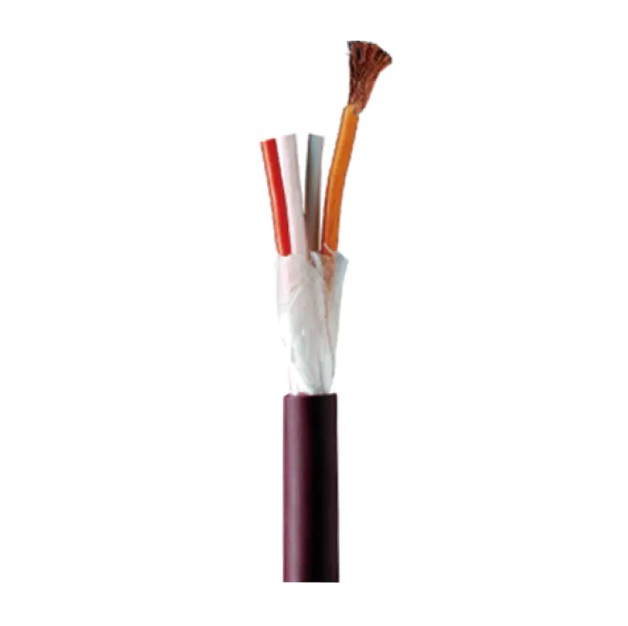
Cable Designed for Direct Burial
Direct burial cable is specifically engineered to be installed underground without conduit, in direct contact with soil. It requires a jacket and insulation system that resists moisture ingress, soil chemicals, earth pressure, and temperature cycling without degrading over a 25–40+ year service life. Standard indoor cable types — NM-B (Romex), THHN, or SOOW cord — are not rated for direct burial and will fail rapidly when buried.
The primary direct burial cable types recognized by the NEC include:
- UF-B (Underground Feeder and Branch-Circuit Cable): The residential direct burial standard. Conductors are individually insulated and encapsulated in a solid PVC jacket that fills the interstices between conductors, providing moisture resistance throughout the cable cross-section. UF-B is rated for 60°C in wet conditions and requires a minimum burial depth of 24 inches for direct burial, or 12 inches when GFCI-protected per NEC Table 300.5.
- USE-2 (Underground Service Entrance): Rated for direct burial and service entrance applications. USE-2 conductors are sunlight-resistant and rated for 90°C in wet or dry conditions, making them suitable for photovoltaic system wiring and service lateral runs from the utility transformer to the meter base.
- THWN-2 / XHHW-2 in conduit: For higher-ampacity underground feeders, individual conductors with wet-location ratings are pulled through PVC Schedule 40 or Schedule 80 conduit — the conduit serves as the mechanical protection, and conduit-in-trench burial depth minimums are shallower (18 inches for PVC conduit per NEC Table 300.5) than direct burial cable.
- Direct burial rated tray cable (TC-ER): Used in industrial and utility applications for multi-conductor power and control circuits buried without conduit at larger scales.
Regardless of cable type, direct burial installations should include a warning tape buried 12 inches above the cable to alert future excavators, and all splices must be made in accessible junction boxes or with gel-filled, waterproof splice kits rated for direct burial — standard wire nuts and electrical tape are not moisture-proof and will fail underground.
Riser vs Plenum Cable: What's the Difference?
Riser and plenum are fire-resistance ratings for communications and low-voltage cable — not electrical power cable — that govern where specific cable types can be installed based on how they behave in a building fire. The ratings exist because cable jacketing and insulation compounds, when burning, can release toxic gases and spread flames through building air pathways. The NEC (Article 800 for communications, Articles 770 and 820 for fiber and coaxial) and building codes mandate specific cable ratings for specific locations.
Plenum Cable (CMP)
A plenum is any space used for air circulation in a building's HVAC system — including the air space above drop ceilings (when used as return air plenums) and raised access floors used for conditioned air distribution. Plenum-rated cable (marked CMP for Communications Multipurpose Plenum) must meet the most stringent fire resistance and smoke generation standards: UL 910 (Steiner Tunnel test), which measures both flame spread and smoke density. Plenum cable jackets are typically made from low-smoke, flame-retardant compounds such as fluorinated ethylene propylene (FEP) or specially formulated PVC. Plenum cable is required by code in any cable run through plenum air spaces. It is the most expensive cable rating tier.
Riser Cable (CMR)
Riser-rated cable (CMR) is tested to UL 1666 (Riser Flame Test), which evaluates the cable's ability to resist flame propagation vertically between floors — the critical concern in a shaft, stairwell, or conduit run that passes through floor assemblies. Riser cable must self-extinguish and not carry flame from one floor to another, but it does not need to meet the low-smoke density requirements of plenum cable. Riser cable uses standard PVC or similar jackets and costs less than plenum. It is appropriate for vertical runs in conduit or cable trays that pass through floors but do not enter plenum air spaces.
The Substitution Hierarchy
NEC cable rating substitution rules follow a strict hierarchy: plenum (CMP) can substitute for riser (CMR), general purpose (CM), or limited use (CMX) cable in any location. Riser can substitute for general purpose or limited use cable. General purpose cable cannot be used in riser or plenum spaces. This means an installer can always use a higher-rated cable in place of a lower-rated one, but never the reverse. The practical implication: a building cabled entirely with plenum-rated cable is fully code-compliant everywhere, but at significantly higher material cost than using riser in shafts and plenum only in air-handling spaces.
| Rating | Marking | Test Standard | Required Location | Typical Jacket |
|---|---|---|---|---|
| Plenum | CMP | UL 910 | HVAC air spaces, return-air ceilings | FEP or low-smoke PVC |
| Riser | CMR | UL 1666 | Vertical floor-to-floor runs, shafts | Standard PVC |
| General Purpose | CM | UL 1581 | Horizontal runs, non-plenum spaces | Standard PVC |
| Limited Use | CMX | UL 1581 | Residential only, short runs | Standard PVC |
 Email:
 Telephone:+86-0514-85086085
 FAX:+86-0514-85086085
 Phone:+86-15861389306