 Email:
  Telephone: +86-0514-85086085
 FAX: +86-0514-85086085
 English
 中文简体
中文简体 русский
 عربى
عربى
Content
Is Copper Wire Pure Copper — or a Compound?
Copper wire used in electrical applications is neither a compound nor a mixture in the chemical sense — it is a pure substance. Elemental copper (chemical symbol Cu, atomic number 29) is a single-element metal, and commercial electrical-grade copper wire is refined to a minimum purity of 99.9% copper by mass. At this purity level, the material's composition is effectively one element, placing it firmly in the category of a pure substance rather than a compound (which would require two or more chemically bonded elements) or a mixture (which would imply mechanically combined substances that retain distinct identities).
The most common grade used for electrical wiring is electrolytic tough pitch (ETP) copper, designated C11000 in the Unified Numbering System (UNS). It contains 99.90% minimum copper plus a controlled trace of oxygen (typically 0.02–0.04%) introduced during the electrolytic refining and casting process. This oxygen content has no meaningful effect on conductivity but slightly improves the metal's grain structure during solidification.
For applications where even trace impurities matter — high-frequency signal cables, medical equipment, semiconductor tooling — oxygen-free high conductivity (OFHC) copper, designated C10100 or C10200, is specified at 99.99% purity. At this level, conductivity reaches its theoretical maximum for the metal, and susceptibility to hydrogen embrittlement at elevated temperatures is eliminated. In all cases, the conductor material is a pure elemental substance, not a compound or alloy.
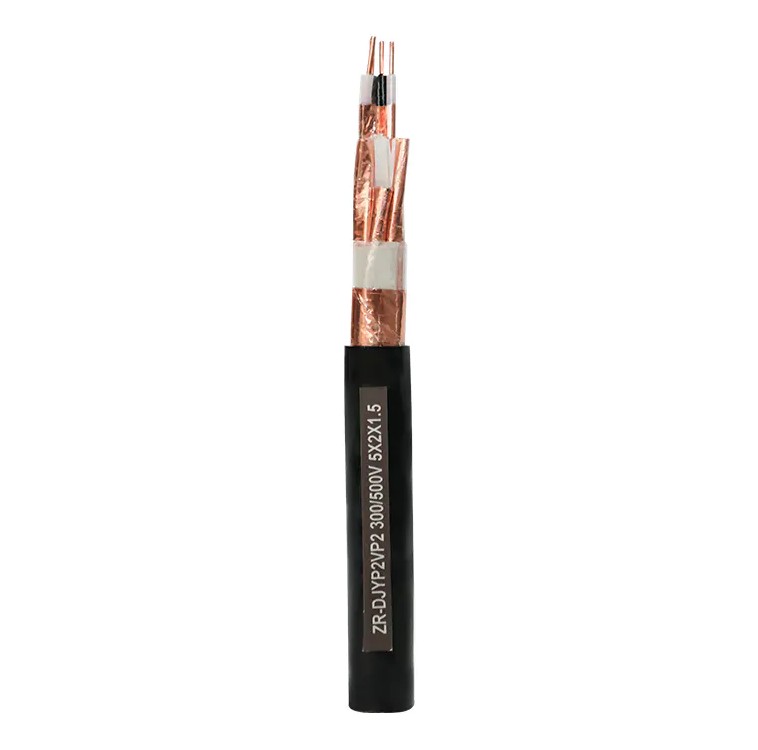
Is Copper a Good Conductor of Electricity?
Copper is one of the most effective electrical conductors of any material available at industrial scale. Its conductivity is rated at 100% IACS — the International Annealed Copper Standard — the baseline reference against which every other conductor material is measured. Only silver (approximately 106% IACS) surpasses it among common metals, and silver's cost makes large-scale wiring applications impractical.
Copper's conductivity originates in its electron configuration. Each copper atom contributes a single, loosely bound valence electron to the metallic lattice. These free electrons are highly mobile — they respond instantly to an applied electric field and drift through the lattice with minimal scattering, producing low resistivity and high current-carrying efficiency. In comparison, aluminum conducts at approximately 61% IACS, meaning an aluminum conductor requires a roughly 60% larger cross-sectional area to carry the same current as copper at equivalent resistance per unit length.
Conductivity is not copper's only electrical advantage. Its oxide layer — which forms naturally on exposed surfaces — remains electrically conductive, unlike the insulating aluminum oxide that forms on aluminum conductors and creates resistance at terminals and joints over time. This property alone is a significant reason why copper remains the preferred material at connection points throughout electrical installations.
Why Is Copper Used for Electrical Wiring?
The selection of copper for electrical wiring is the result of its unique convergence of electrical, mechanical, thermal, and practical properties — no single alternative metal matches it across all of these dimensions simultaneously.
Electrical Performance
With resistivity of 1.72 × 10⁻⁸ Ω·m at 20°C, copper minimizes resistive losses in conductors carrying current over distance. Lower resistivity means less energy lost as heat, smaller conductor sizes for a given current rating, and lower voltage drop over circuit runs. In large installations — industrial plants, data centers, commercial buildings — the cumulative energy savings from copper's conductivity advantage over alternative materials are economically significant over decades of service.
Mechanical Flexibility and Durability
Copper's ductility allows it to be drawn into wire diameters as fine as 0.02 mm and bent, routed, and terminated repeatedly without cracking. Its tensile strength in annealed form (200–250 MPa) is sufficient to withstand installation stresses, while hard-drawn grades reach 380–420 MPa for overhead conductor applications. Copper does not cold-creep under sustained mechanical load at service temperatures — unlike aluminum, which flows gradually under clamp pressure at terminals, progressively loosening connections and creating resistance points and fire hazards.
Corrosion and Oxidation Behavior
Copper is corrosion-resistant across all common indoor environments and most outdoor and underground installation conditions. Its surface oxide (cuprous and cupric oxide) forms a stable, thin passivation layer that inhibits further corrosion without meaningfully increasing contact resistance at electrical joints. Direct-buried copper grounding conductors maintain electrical integrity for 40–50 years in most soil conditions without protective coating.
Termination and Connection Compatibility
Copper is compatible with the complete range of electrical termination methods: solder joints, mechanical screw terminals, crimp lugs, pressure connectors, and wire-nut splices. Its surface accepts solder alloys readily, and the slightly conductive oxide layer does not impede connection quality the way aluminum oxide does. This universal termination compatibility simplifies system design, reduces the need for specialized connectors, and lowers installation error risk.
Recyclability and Long-Term Supply
Copper retains 100% of its electrical properties after recycling, and the global copper recycling infrastructure is well established — recycled copper accounts for approximately 35–40% of total supply. From a long-term resource perspective, copper's recyclability reduces lifecycle cost and environmental impact, reinforcing its position as the sustainable conductor material of choice for long-lived electrical infrastructure.
Melting Point of Copper Wire
Pure copper melts at 1,085°C (1,984°F) — a melting point high enough to make copper wire stable under all normal electrical service conditions and the vast majority of fault conditions as well. This thermal robustness is a direct engineering advantage: a copper conductor carrying fault current during a short circuit event can absorb significant energy before reaching melting temperature, giving overcurrent protection devices (fuses and circuit breakers) time to interrupt the circuit before the conductor is damaged.
In practice, the insulation surrounding the conductor fails at far lower temperatures than the copper itself. Common PVC insulation begins to soften around 70–90°C and degrades at 105–120°C. Cross-linked polyethylene (XLPE) insulation is rated for continuous operation at 90°C with short-circuit ratings to 250°C. Silicone rubber insulation can withstand 180–200°C continuously. In all standard insulated cable constructions, the insulation system — not the copper conductor — defines the thermal limit of the cable.
For bare copper applications — exposed bus bars, overhead conductors, and grounding electrodes — the copper melting point becomes more directly relevant. Fault current capacity calculations for grounding conductors explicitly account for the conductor's ability to carry prospective fault current for the clearing time of the upstream protective device without reaching the melting point of copper, using the Onderdonk equation or tabulated values in standards such as IEEE 80 and IEC 60364.
| Thermal Property | Value | Significance |
|---|---|---|
| Melting point | 1,085°C (1,984°F) | Conductor survives fault events that destroy insulation |
| Max continuous service temp (insulated) | 60–105°C (insulation-limited) | Determined by insulation type, not conductor |
| Thermal conductivity | 401 W/(m·K) | Dissipates resistive heat efficiently along conductor length |
| Coefficient of thermal expansion | 17 × 10⁻⁶ /°C | Moderate — compatible with most terminal hardware |
| Specific heat capacity | 0.385 J/(g·°C) | Determines short-circuit thermal energy absorption capacity |
How Is Copper Wire Produced?
The production of copper wire is a multi-stage industrial process that begins with ore extraction and ends with finished conductor in a precisely specified diameter and temper. Each stage directly influences the electrical and mechanical properties of the final wire.
Mining and Smelting
Copper ore — primarily chalcopyrite (CuFeS₂) and other sulfide minerals — is mined from open-pit and underground deposits. The ore is concentrated by flotation to approximately 25–35% copper content, then smelted in flash furnaces at temperatures exceeding 1,200°C to produce blister copper at 98–99% purity. The blister copper is then fire-refined to anode copper at 99.5% purity.
Electrolytic Refining
Anode copper plates are suspended in an electrolytic bath of copper sulfate solution alongside pure copper cathode blanks. When direct current is applied, copper dissolves from the anode and deposits with exceptional purity onto the cathode. Electrolytic refining produces cathode copper at 99.99% purity — eliminating silver, gold, selenium, tellurium, arsenic, and other impurities that would otherwise reduce conductivity. The "anode slime" collected at the bottom of the refining tank contains valuable precious metal byproducts recovered separately.
Rod Casting (Continuous Casting)
Cathode copper is melted and cast into rod — typically 8 mm diameter — using a continuous casting and rolling process (the most common is the Contirod or SCR process). The rod exits the casting machine and passes immediately through a series of rolling mills that reduce it to the target diameter while the copper is still hot and workable. This hot-rolling process also refines the grain structure. The resulting copper rod is the feedstock for wire drawing mills.
Wire Drawing
Wire drawing reduces copper rod to final wire diameter by pulling it through a series of tungsten carbide dies, each slightly smaller than the last. A lubricant — typically an emulsion or soap-based compound — reduces friction and heat at the die interface. Each pass through a die reduces the diameter by 15–25% and proportionally increases the wire length. A typical drawing sequence takes 8 mm rod down to finished wire in 10–15 drawing passes.
Wire drawing work-hardens the copper, increasing tensile strength while reducing ductility and electrical conductivity slightly. Annealing — controlled heating to 200–500°C — restores ductility and conductivity by relieving internal stresses and recrystallizing the grain structure. Most electrical wire is supplied in the annealed condition for maximum flexibility and conductivity. Hard-drawn wire, used in overhead conductors and spring contacts, is drawn to final dimension without annealing.
Stranding, Insulating, and Cabling
Finished drawn wire is stranded — twisted together in configured bundles — on stranding machines to produce the conductor constructions required for flexible cables. Insulation is applied by extrusion: the conductor passes through a crosshead die where molten PVC, XLPE, TPE, or other insulation compound is extruded uniformly around it and cooled. For XLPE insulation, a subsequent crosslinking process (steam, silane, or electron-beam curing) creates the three-dimensional polymer network that gives cross-linked insulation its elevated temperature rating. Multiple insulated conductors are then cabled together, filled if required, and oversheathed to produce finished cable.
Where Copper Is Used in Electrical Systems
Copper's combination of properties makes it the conductor of choice across the full spectrum of electrical applications — from the finest signal wire in a microphone to the heaviest feeder cable in a substation.
- Building wiring — branch circuit conductors, service entrance cables, feeder runs, and grounding conductors in residential, commercial, and industrial construction are predominantly copper, governed by the National Electrical Code (NEC) in North America and IEC 60364 internationally.
- Power transformers — distribution and power transformers use copper winding wire in both primary and secondary coils. The transformer's efficiency and temperature rise are directly related to the resistivity of its winding conductors.
- Electric motors and generators — stator and rotor windings in AC and DC machines are wound from magnet wire — a fine copper conductor with thin enamel insulation — enabling the high slot fill density required for efficient electromagnetic energy conversion.
- Renewable energy — solar string cables, wind turbine generator windings, and battery storage system busbars all rely on copper for their current-carrying elements.
- Electric vehicles — motor windings, battery pack interconnects, charging cables, and the high-voltage harness connecting drivetrain components are copper throughout. An EV contains two to four times the copper of a comparable internal combustion vehicle.
- Data and telecommunications — structured cabling networks (Cat5e through Cat8), coaxial distribution systems, and legacy telephone copper pairs all use copper as the signal conductor, exploiting its combination of low resistivity and reliable termination characteristics.
Across all of these applications, the fundamental reasons copper is used in electrical wiring remain constant: no other material combines its conductivity, mechanical workability, corrosion resistance, termination compatibility, and long-term reliability at a competitive cost for large-scale deployment. The properties that made copper the foundation of the first telegraph networks in the 1840s remain the same properties that make it the conductor of choice for 21st-century electrification infrastructure.
 Email:
 Telephone:+86-0514-85086085
 FAX:+86-0514-85086085
 Phone:+86-15861389306